

Safe, Transparent, and Scalable Pathways to Enterprise Productivity
Enterprises no longer have an AI adoption problem. They have an AI value problem.
Over the past few years, organisations have invested heavily in generative AI, launched pilots, provided employees with co-pilots and experimented with increasingly capable models and AI agents. The technology has developed at extraordinary speed and individual examples of its potential are compelling. Yet a more uncomfortable question is beginning to emerge in leadership. Where is the sustained enterprise productivity gain? It is relatively easy to demonstrate that AI can summarise a document, generate software code, analyse information or draft a report. It is considerably harder to translate thousands of such individual improvements into lower operating costs, faster processes, better customer outcomes or genuinely increased organisational capacity. This gap between AI activity and enterprise value is likely to define the next phase of adoption.
The challenge is not simply technological. Most enterprises were designed around people working through processes supported by applications, documents, email and data. Generative AI introduces a fundamentally different capability: technology that can interpret unstructured information, generate content, reason across sources and increasingly undertake sequences of actions. Simply adding this capability to existing ways of working may make individual tasks faster, but it rarely captures the full opportunity. Sustainable productivity improvement requires organisations to reconsider how work itself is performed—while ensuring that the resulting processes remain safe, transparent and accountable.
Start with work, not AI
A common approach to AI adoption has been to acquire the technology and then look for applications. Organisations provide employees with AI tools, establish innovation programmes and collect hundreds of potential use cases. This encourages experimentation, but it can also create what might be called AI ‘presenteeism’, significant visible activity without equivalent improvement in organisational performance. A more productive starting point is the workflow. Enterprises contain thousands of processes in which people repeatedly search for information, reconcile data, transfer information between systems, produce documents, check outputs, respond to routine requests or wait for decisions. These friction points provide natural opportunities for AI, particularly when AI is combined with existing automation and enterprise systems.
Consider procurement. Staff may spend substantial time interpreting requirements, reviewing previous procurements, identifying relevant contractual clauses, comparing supplier submissions and preparing evaluation material. AI can accelerate many of these activities, but the objective should not simply be to produce procurement documents more quickly. The greater opportunity is to redesign the process so that relevant information is assembled automatically, AI supports analysis and identifies exceptions, and people concentrate their time on commercial judgement, negotiation and decisions. The same principle can apply to customer service, finance, HR, software development, operations and professional services. This is the critical distinction between individual productivity, process productivity and enterprise productivity. AI can make an individual employee faster relatively easily; creating measurable productivity across an organisation requires those improvements to become embedded in repeatable processes.
Safe and transparent by design
Embedding AI into operational workflows inevitably creates questions around data protection, security, intellectual property, accuracy and accountability. The answer, however, should not be to surround every AI application with the same level of governance. An employee using an approved AI service to summarise an internal meeting presents a very different risk from an AI system contributing to a credit decision, determining eligibility for a public service or making recommendations in a safety-critical environment. Governance should therefore be proportionate to consequence. Organisations need clear policies defining which models and services are approved, what information can be shared with them, how access is controlled, when human review is mandatory and how higher-risk applications are evaluated and monitored. The objective should be a safe-to-scale environment: strong enough to protect the enterprise while practical enough that employees can innovate within clearly understood boundaries.
Transparency is equally important, although it should be defined in practical rather than purely technical terms. Enterprises do not necessarily need every user to understand the mathematics within a large language model. They do need to be able to answer: What information did the system use? What did AI generate or recommend? What checks were performed? How did the output influence the process? Who made the final decision? As AI moves from assisting employees towards undertaking increasingly autonomous tasks, these questions become more important, not less. The degree of oversight should increase with the potential consequence of the activity. AI may undertake more of the work, but organisational accountability cannot become ambiguous.
From AI assistant to AI-enabled enterprise
The first generation of enterprise AI has largely centred on copilots: tools that help individuals draft, summarise, search, analyse and code. These can deliver worthwhile productivity improvements, but the underlying business process frequently remains unchanged. The larger opportunity emerges when organisations redesign workflows around the complementary strengths of people, AI and conventional automation. A traditional process might require an employee to retrieve information from several systems, analyse it manually, create a document, send it for review and subsequently enter the outcome into another application. An AI-enabled process could retrieve relevant information automatically, generate an initial analysis, identify exceptions requiring attention, prepare a recommended action and route it to the appropriate person. Following approval, downstream actions could be initiated automatically. The human has not necessarily disappeared; their role has changed from processing information to exercising judgement, managing exceptions and making decisions.
A pragmatic pathway from experimentation to enterprise productivity
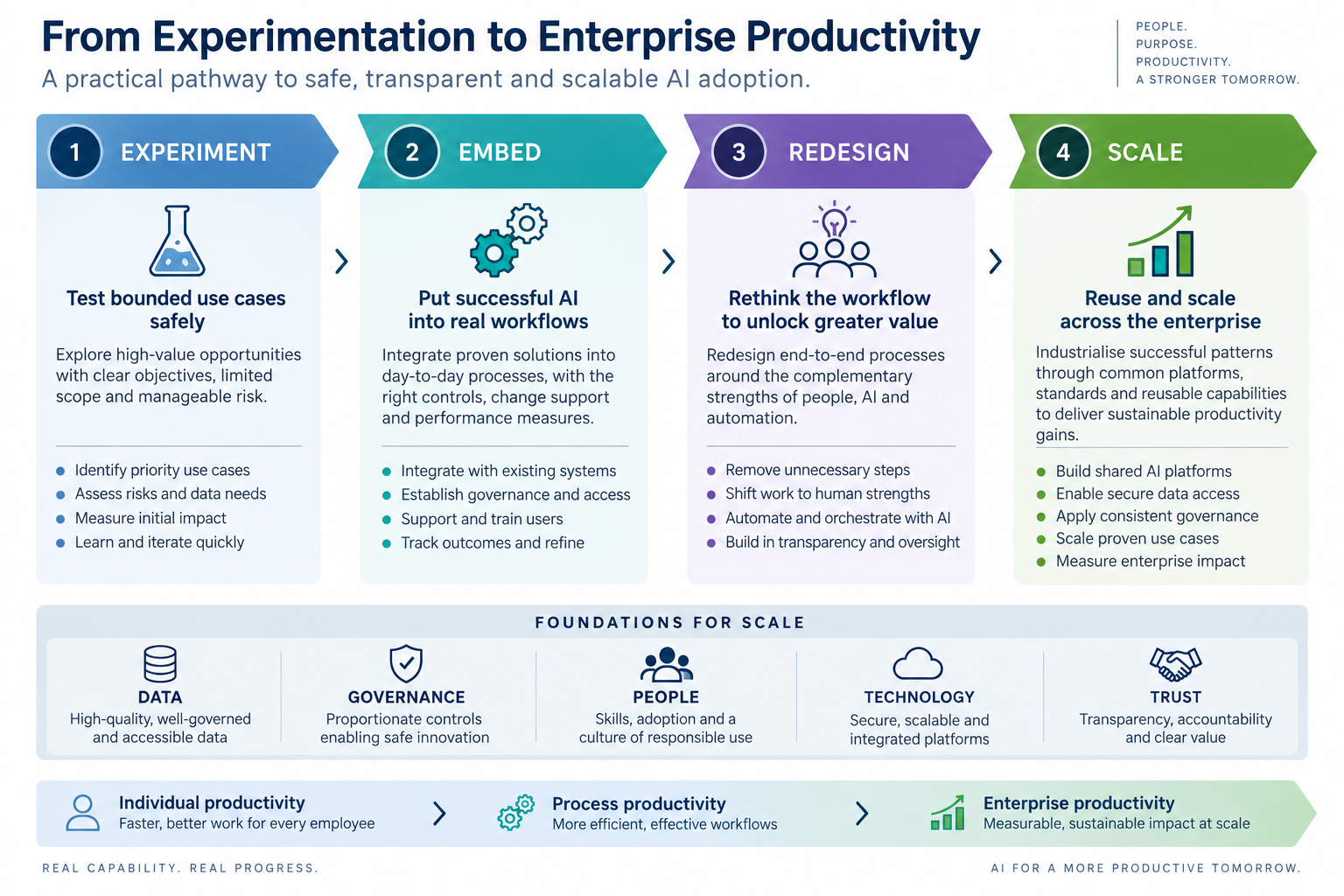
This approach provides a pragmatic progression. Experiment with bounded problems where both the potential value and the risk can be understood. Embed successful capabilities into operational workflows rather than leaving them as standalone tools. Redesign the workflow itself around the different strengths of people, AI and automation. Finally, scale successful patterns using common platforms, governance, data access, integration and reusable components. These stages are not simply a technology maturity model. They represent an increasingly sophisticated understanding of how AI creates value. Many organisations already have considerable activity in experimentation and pockets of embedded AI. The greater prize lies in redesigning work and creating the organisational capabilities required to reproduce those improvements repeatedly.
Measure productivity, not AI activity
This also requires a change in how success is measured. Numbers of licences, employees trained, prompts submitted or AI use cases launched demonstrate activity rather than productivity. Each significant AI intervention should instead begin with a baseline for the process it is intended to improve. Measures might include cycle time, cost per transaction, first-time-right rates, error rates, customer response times, employee hours released or service quality. This creates a disciplined mechanism for separating promising demonstrations from interventions that genuinely improve performance. It also makes experimentation safer: organisations can test ideas, gather evidence, scale what works and stop what does not without treating every pilot as something that must eventually become a production system.
Once successful applications emerge, enterprises also need to resist rebuilding the same capabilities repeatedly. If every business unit independently chooses models, creates integrations, defines controls and develops monitoring, AI will rapidly become fragmented, expensive and difficult to govern. Scaling requires reusable enterprise capabilities: approved models and platforms, secure access to organisational data, common integration patterns, identity controls, evaluation frameworks, monitoring and reusable AI components. Governance, technology and productivity therefore become closely connected. The same foundations that make AI safer can also make it easier and cheaper to scale.
The next phase: from adoption to productivity
Generative AI will continue to develop rapidly, and each new generation of models and agents will produce another wave of attention. But technological capability is unlikely to remain the principal constraint on enterprise value. The harder questions concern workflows, operating models, organisational data, governance, trust and change. Enterprises therefore need to resist measuring progress by how much AI they have deployed. The more meaningful question is whether AI is making the organisation measurably better at what it does.
The organisations that ultimately capture the greatest value will not necessarily be those that experiment with every new AI capability first. They will be those that develop the organisational discipline to convert rapidly changing technology into trusted, measurable and repeatable improvements in how work gets done. Moving past the hype therefore means treating AI not simply as another technology deployment, but as an opportunity to rethink enterprise productivity. The destination is not an organisation in which AI is everywhere. It is an organisation in which people, data, AI and automation work together deliberately—and where every deployment can demonstrate why it exists, what value it creates and who remains accountable.